The Four Treasures of
Chinese Brush Painting
The primary materials used in Chinese brush painting are brushes, ink sticks, ink stones, and paper. These are known as the Four Treasures. Their history, like that of Chinese brush painting itself, spans several thousand years.
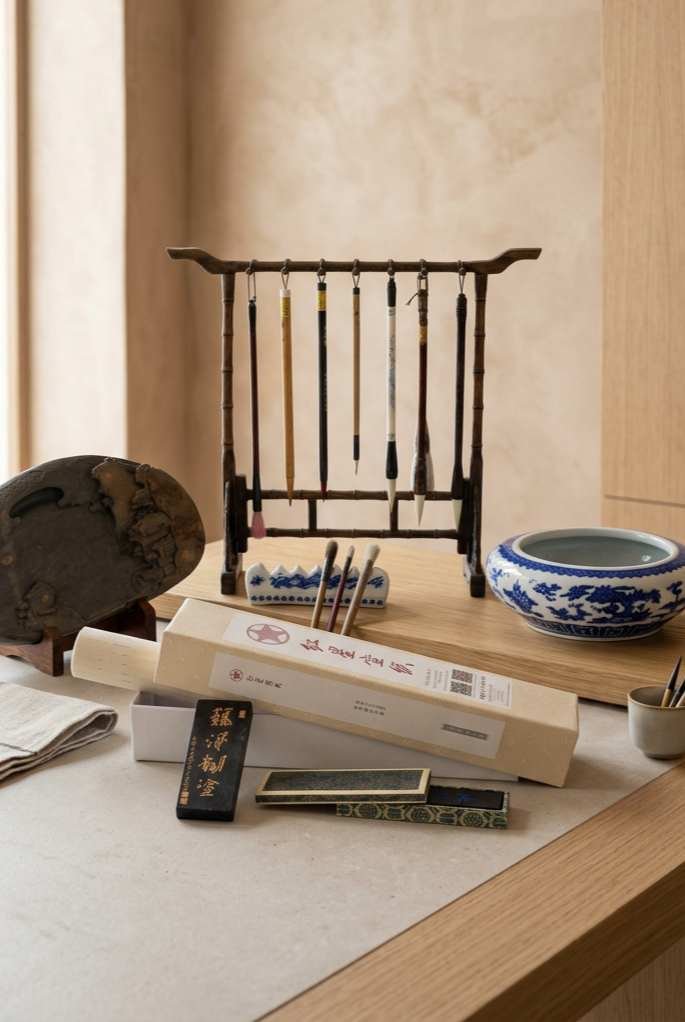
Brushes
There are two main types of brush hair: white hair and brown hair.
White hair brushes are often made from goat hair. Because they are soft and highly absorbent, they are commonly used for painting flowers and birds, as well as for colour washes.
Brown hair brushes may be made from weasel hair, horsehair, human hair, pig bristles, or bird feathers. These brushes are stiffer and are well suited to contouring and depicting tree branches, bamboo, and landscapes.
Brushes vary in size and can be up to four inches long.
Paper
Paper was invented in China. The paper traditionally used for painting is known as Xuan paper, often referred to in the West as rice paper. It is fine, soft, durable, and made from a variety of materials, including bamboo, mulberry bark, rice straw, and rattan.
There are two main types of Xuan paper: sized and unsized.
Unsized paper absorbs water, colour, and ink quickly, making it well suited to freehand painting styles. Sized paper is less absorbent and is ideal for detailed, precise work.
The paintings in this exhibition are created on unsized paper.
Ink Sticks
Ink gives Chinese painting its distinctive character. Traditionally, ink sticks are rectangular in shape and are made from pine soot and resin, often mixed with herbs.
Today, however, prepared liquid inks are becoming increasingly popular.
Ink Stones
Ink stones are made from specially selected stone, often sourced from mountain streams. Ink is prepared by placing a few drops of water onto the stone and then grinding the ink stick in a circular motion.
While the process appears simple, achieving the correct consistency requires skill and experience.